

The scene repeats itself across Latin America. An education authority buys tablets. It hires a training course. Teachers learn to open the platform, upload a file, project a video. Certificate signed, indicator met.
And the following Monday the class is exactly the same as before. The teacher still talks at the front; the students still copy. Only now the board is digital.
During my doctorate at UFRGS I spent years trying to understand why this happens. It is not teacher laziness. It is not resistance to change. It is a measurement error: we are assessing the wrong thing.
Literate is not the same as lettered
The distinction comes from linguistics, and we owe its clearest formulation to Magda Soares and Marcelo Buzato. To become literate is to master the technique: recognising letters, composing words. To become lettered is to use that technique in real social practices — reading a contract and understanding what you are signing, writing a letter that achieves something.
As Soares puts it, there is no sense in learning a technique and not knowing how to use it. And Buzato is even blunter: literacy makes lettering possible, but it does not guarantee it.
Move that to digital ground and the diagnosis becomes uncomfortable. The vast majority of our teacher training programmes produce literacy. Almost none produce lettering. They teach how to operate the device — hardware, software, internet — and take for granted that pedagogical use will follow on its own. It does not follow on its own. It never did.
A competence that is not mobilised in practice is not a competence: it is an inert resource.
Perrenoud formulated it years before any of us: knowing a word processor is a necessary condition for integrating the computer into the classroom, but if the training does not work explicitly on that integration, the resource stays in potential and ends up useless. Competence, for him, is not knowing: it is knowing how to mobilise.
The Latin American context makes the problem sharper
There is one figure worth keeping in mind before designing any policy. According to OECD data, the average age of our teachers is in the mid-forties. In other words: most of the region's teaching workforce was trained in the analogue era and works in the digital one. They are what I called, in the research, digital migrants.
And how did they learn to use technology? Mostly on their own. Studies show that around four in ten teachers describe themselves as self-taught, another third learned with help from family or colleagues, and only a minority went through a formal course.
A self-taught teacher learns the tool, not the didactics of the tool. They learn to make the slide; they do not learn that the slide, badly used, is exactly the same lecture as always with better typography.
The problem is not that teachers lack technology. It is that the training they receive ends where it should begin.
Two lenses that never crossed
Historically, we have looked at teachers in two separate ways.
On one side, we measure their digital competence: how well they handle devices, platforms, resources. There are international frameworks for this — UNESCO's, the ICT competence pentagon of Colombia's Ministry of Education — and building on them I developed and validated a model of my own, COPROMIDI, to diagnose where a digital-migrant teacher stands.
On the other side, we measure their performance in pedagogical practice: how well they teach, how they structure the class, how they assess, what they do with their students.
The problem is that these two lenses almost never cross. And on their own, each one lies.
A teacher can have very high digital competence and a completely transmissive pedagogical practice — mastering the tool and using it to reinforce the very model they claim to want to move beyond. And the reverse: a teacher with excellent pedagogical practice may have low digital competence and be wasting possibilities they do not even know exist.
What letramento praxital is
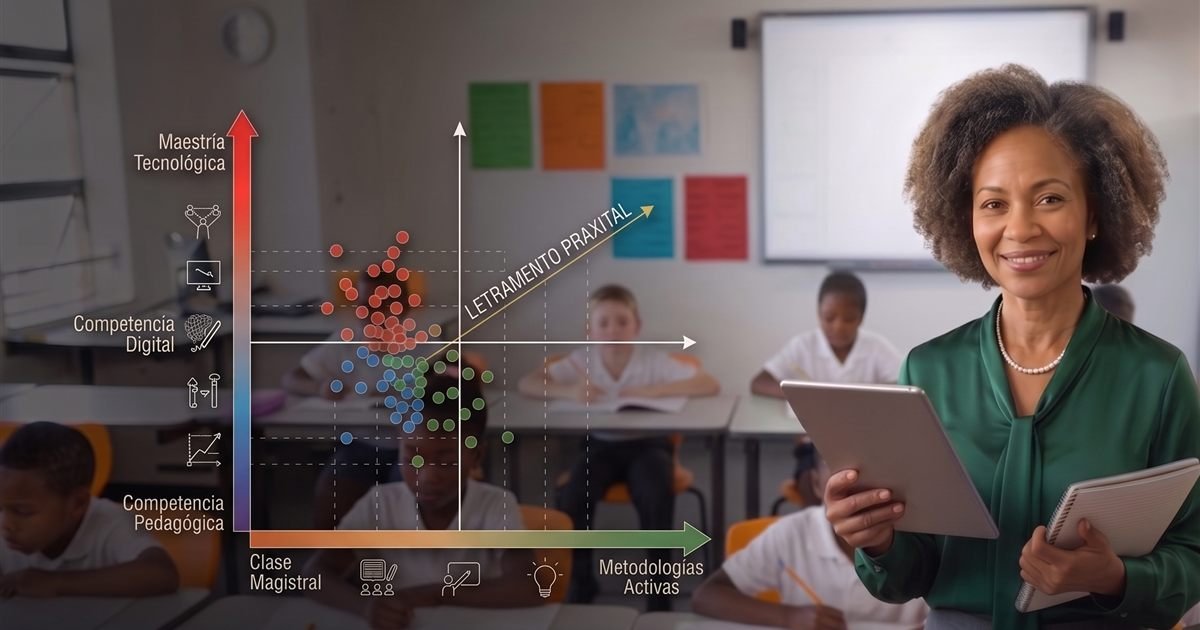
The concept was born from that crossing. Letramento praxital is the degree to which a teacher converts their digital competences into real transformation of their pedagogical practice. It is not what they know. It is not what they do. It is the relationship between the two.
The name is not accidental. Praxis, in Freire, is reflection and action upon the world in order to transform it — not theory on one side and practice on the other, but both in a single movement. The praxital is that praxis crossed by the digital: the point where technical knowledge stops being accumulated information and becomes the capacity to change something in the classroom.
In the thesis this took shape as a matrix that crosses both variables and locates each teacher at a concrete point: not an abstract score, but a diagnosis that says which way they need to move. That matrix was tested in a continuing-education process with teachers from public schools in Valledupar, Colombia — two months, four in-person meetings, sixteen hours of distance work, using the flipped classroom both as method and as object of study.
That last detail matters more than it seems. The teachers did not learn about active methodologies: they lived them as students before applying them as teachers. It is hard to teach in a way you have never experienced.
Three consequences for anyone designing education policy
- Buying technology is not training teachers. No equipment indicator predicts pedagogical change. The correlation is weak and the evidence has been showing it for twenty years.
- Certifying hours is not certifying transformation. If the training does not require evidence of modified practice, it is measuring attendance, not learning.
- The diagnosis must be twofold. Assessing only digital competence or only pedagogical performance produces wrong decisions. Only the crossing says anything useful.
Conversación
Los comentarios se revisan antes de publicarse. Sé respetuoso: aquí se debate con ideas.
Para publicarlo, identifícate
Pedimos identificación para mantener la conversación limpia. Tu correo nunca se publica.
¡Gracias por comentar!
Tu mensaje quedó en revisión. Aparecerá pronto.